What Is Astrology and How Did It Begin?
A journey through history to discover the roots of astrology from ancient Babylon to the modern era.
Astrology is one of humanity's oldest symbolic systems — a framework that maps the positions of the Sun, Moon, and planets onto human experience. Whether you approach it as a spiritual practice, a psychological tool, or simple curiosity, understanding what astrology actually is and where it came from gives you a far richer context for reading your horoscope or birth chart.
What Astrology Is — and What It Is Not
Astrology is the study of the relationship between celestial bodies and life on Earth. Astrologers track the positions of the Sun, Moon, Mercury, Venus, Mars, Jupiter, Saturn, Uranus, Neptune, and Pluto against the backdrop of the zodiac — a band of twelve constellations that the Sun appears to travel through over the course of a year.
It is important to be clear: astrology is not astronomy. Astronomy is the scientific study of celestial objects and phenomena. Astrology is a symbolic interpretive system that uses those same objects as a language for understanding personality, timing, and human experience. Modern astrology does not claim to predict the future with certainty or to override free will. It offers a lens — one of many — for self-reflection.
The Origins of Astrology: Ancient Babylon
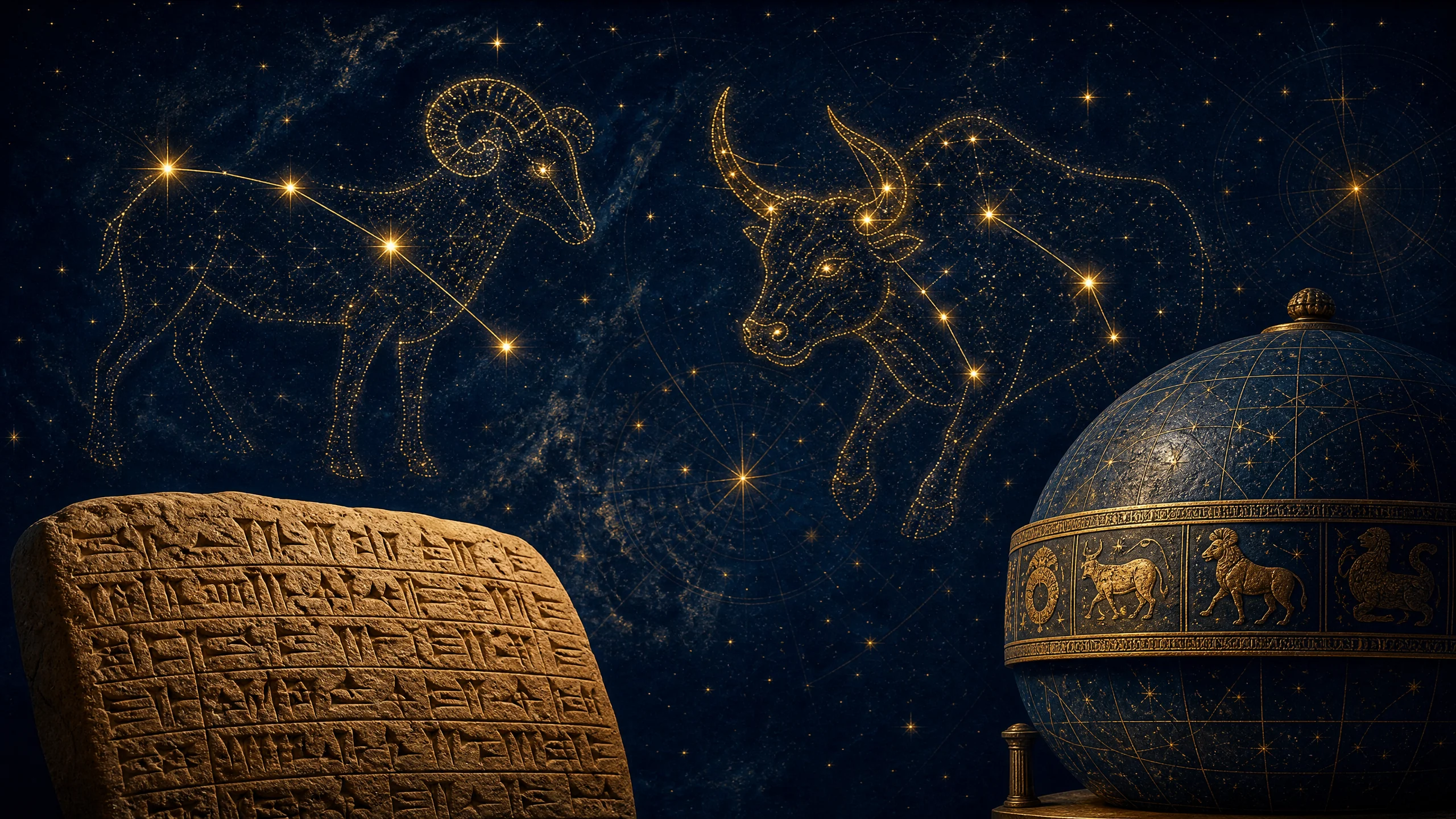
The earliest systematic astrology we know of emerged in ancient Mesopotamia — present-day Iraq — around 2000 BCE. Babylonian sky-watchers called omen astrologers catalogued celestial events and linked them to earthly outcomes: a lunar eclipse might portend the death of a king; the appearance of Venus in a certain position might signal a good harvest. These observations were recorded in cuneiform tablets, some of which survive today.
The Babylonians developed the twelve-sign zodiac around the 5th century BCE, dividing the ecliptic — the Sun's apparent path — into twelve equal 30-degree segments and naming each after a nearby constellation. This is the zodiac that Western astrology still uses.
Greek and Hellenistic Astrology
When Alexander the Great conquered Persia and Babylon in the 4th century BCE, Babylonian astronomical knowledge flowed into the Greek world. Greek philosophers were fascinated. They merged Babylonian sky-lore with their own cosmological ideas — particularly the four elements (fire, earth, air, water) — to create what we now call Hellenistic astrology.
The most influential figure of this era was Claudius Ptolemy, a 2nd-century CE mathematician and astronomer who wrote the Tetrabiblos — a comprehensive manual of astrological theory that remained the standard reference for over a thousand years. Ptolemy systematised the signs, planets, houses, and aspects into a coherent framework that still underlies Western astrology today.
Astrology in the Medieval and Renaissance World
During the medieval period, astrology was not a fringe pursuit — it was a respected academic discipline taught at European universities alongside medicine, philosophy, and theology. Physicians used it to time treatments; rulers consulted court astrologers before making major decisions; architects incorporated astrological symbolism into buildings.
The Renaissance saw a flowering of astrological practice. Figures such as Marsilio Ficino and Giovanni Pico della Mirandola debated astrology's philosophical implications. By the 17th century, however, the Scientific Revolution began to separate astronomy from astrology. As Copernicus, Galileo, and Newton demonstrated that the Earth orbited the Sun rather than the reverse, the cosmological model underlying traditional astrology was overturned — and astrology gradually lost its academic status in the West.
Indian and Chinese Astrological Traditions
Western astrology is not the only tradition. Vedic astrology (Jyotish), which developed in India, shares the twelve-sign zodiac but uses the sidereal zodiac — aligned with the actual constellations — rather than the tropical zodiac used in the West. Vedic astrology places particular emphasis on the Moon sign and the lunar mansions (nakshatras), and it remains widely practised across South Asia today.
Chinese astrology operates on an entirely different system: a twelve-year cycle in which each year is associated with an animal (Rat, Ox, Tiger, and so on) and one of five elements. Your Chinese zodiac sign is determined by your birth year, not your birth month. The two systems are independent and can be explored separately or together.
The Twelve Zodiac Signs
The zodiac is divided into twelve equal segments of 30 degrees each. The Sun spends approximately one month in each sign, and the sign it occupied at the moment of your birth is your sun sign — the placement most commonly referenced in popular astrology. The twelve signs, in order, are: Aries, Taurus, Gemini, Cancer, Leo, Virgo, Libra, Scorpio, Sagittarius, Capricorn, Aquarius, and Pisces.
Each sign belongs to one of the four elements (fire, earth, air, water) and one of three modalities (cardinal, fixed, mutable). These two layers combine to give each sign its unique character. For a deeper look at how the elements and modalities work together, see our guide to zodiac elements.
How a Birth Chart Works
Your sun sign is the most visible layer of astrology, but a full birth chart (also called a natal chart) is far more detailed. It maps the position of every planet at the exact moment of your birth, placing each one in a sign and a house — a twelve-fold division of the sky based on your birth time and location.
The most important placements in a birth chart are:
- Sun sign: your core identity and conscious self-expression.
- Moon sign: your emotional nature, instincts, and inner life.
- Rising sign (Ascendant): how you appear to others and your approach to new situations.
- Mercury: how you think and communicate.
- Venus: what you value and how you relate in love.
- Mars: how you act, assert yourself, and handle conflict.
You can calculate your full birth chart with the free Orveluna birth sign calculator.
Astrology Today: Entertainment, Self-Reflection, and Community
In the 21st century, astrology has experienced a remarkable revival — particularly among younger generations. Social media has made horoscope content ubiquitous, and apps offer personalised daily readings to millions of users. Astrology functions today less as a predictive science and more as a shared language for discussing personality, relationships, and life timing.
At Orveluna, every forecast is grounded in real planetary data. We are transparent that our content is for entertainment and reflection, not scientific guidance. We believe astrology is most valuable when it prompts genuine self-inquiry — not when it is used as a substitute for professional advice or critical thinking.
Frequently Asked Questions
Is astrology a science?
No. Astrology is not a science in the empirical sense. Controlled studies have not found evidence that sun signs reliably predict personality or life outcomes. Astrology is better understood as a symbolic system — a humanistic tool for reflection rather than a predictive science.
What is the difference between Western and Vedic astrology?
Western astrology uses the tropical zodiac, anchored to the seasons (the Sun enters Aries at the spring equinox). Vedic astrology uses the sidereal zodiac, anchored to the actual positions of the constellations. Because of a phenomenon called the precession of the equinoxes, the two zodiacs are currently about 23 degrees apart — which is why your Vedic sun sign is often one sign earlier than your Western sun sign.
What is a sun sign?
Your sun sign is the zodiac sign the Sun was in on the day you were born. It is the most commonly referenced placement in popular astrology and represents your core identity and life purpose. To find yours, use the Orveluna birth sign calculator.
Can astrology predict the future?
Astrology can describe tendencies, themes, and timing — but it does not predict specific events with certainty. Most contemporary astrologers emphasise that the birth chart shows potential, not fate. How you respond to planetary influences is always a matter of personal choice.
Conclusion
Astrology is a rich, multilayered tradition with roots stretching back four millennia. Whether you are drawn to it for its historical depth, its psychological insights, or simply the pleasure of reading your daily horoscope, understanding its origins and structure helps you engage with it more thoughtfully. Explore the twelve zodiac sign profiles on Orveluna, or check your compatibility with any other sign using our compatibility tool.