Ruling Planets: How Do They Influence Your Personality?
Every sign has a ruling planet that gives it a special character — learn about the planets and their influences.
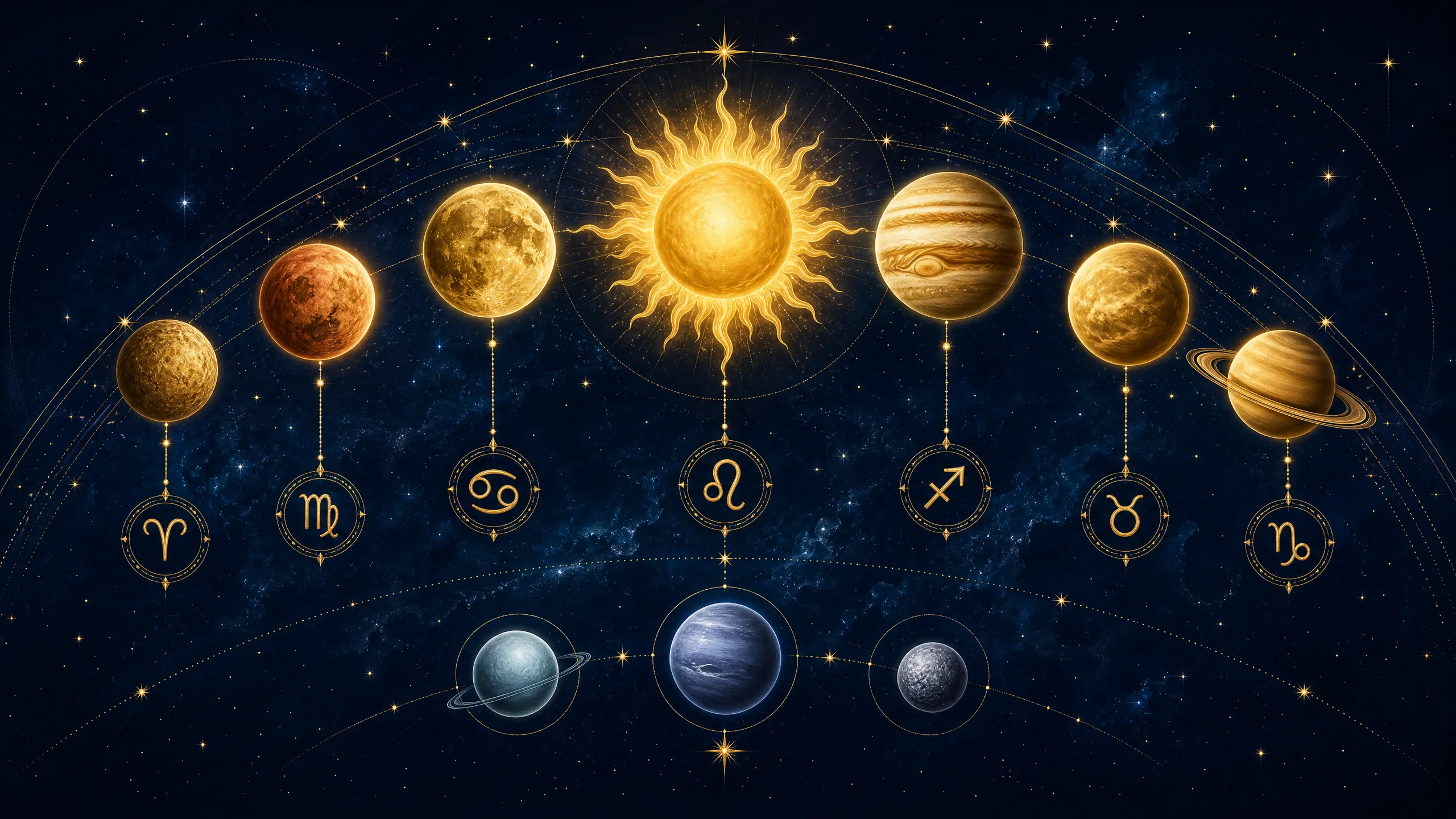
In astrology, every zodiac sign has a ruling planet — a celestial body whose energy is said to resonate most naturally with that sign's qualities. The ruling planet is like the sign's home base: when a planet is in its own sign, it operates with particular ease and strength. Understanding the planetary rulers is one of the most direct ways to deepen your understanding of any sign.
The Origins of Planetary Rulership
The concept of planetary rulership dates back to Hellenistic astrology, developed between roughly 300 BCE and 600 CE. Ancient astrologers assigned the seven visible celestial bodies — the Sun, Moon, Mercury, Venus, Mars, Jupiter, and Saturn — to the twelve signs in a symmetrical pattern based on each planet's distance from the Sun and its perceived qualities.
The system was elegant: the Sun and Moon each ruled one sign (Leo and Cancer respectively), and the remaining five planets each ruled two signs — one on either side of the Leo-Cancer axis. This arrangement, called the thema mundi or "chart of the world," remained the standard for over two thousand years.
The Seven Classical Rulers
Here is the complete classical rulership system, still used as the foundation in both Western and Vedic astrology:
- Sun → Leo: The Sun represents vitality, identity, and conscious self-expression. Leo, the sign of the performer and the leader, embodies solar energy at its most radiant.
- Moon → Cancer: The Moon represents emotion, instinct, and the inner life. Cancer, the sign of the nurturer and the home, reflects lunar sensitivity and protectiveness.
- Mercury → Gemini and Virgo: Mercury is the planet of communication, thought, and information. Gemini expresses Mercury's quicksilver curiosity; Virgo channels it into precision and analysis.
- Venus → Taurus and Libra: Venus governs beauty, pleasure, and relationship. Taurus expresses Venus through sensory enjoyment and material comfort; Libra through aesthetics, harmony, and partnership.
- Mars → Aries and Scorpio: Mars is the planet of action, desire, and conflict. Aries channels Mars as direct, outward drive; Scorpio as strategic, inward intensity.
- Jupiter → Sagittarius and Pisces: Jupiter represents expansion, wisdom, and abundance. Sagittarius expresses this through philosophical exploration; Pisces through spiritual and compassionate openness.
- Saturn → Capricorn and Aquarius: Saturn is the planet of structure, discipline, and limitation. Capricorn embodies Saturn's drive for achievement; Aquarius its capacity for principled detachment.
The Modern Rulers: Uranus, Neptune, and Pluto
The discovery of three outer planets between 1781 and 1930 prompted modern astrologers to reassign rulerships for three signs. These planets move so slowly — taking decades to complete a single zodiac cycle — that they are considered generational influences rather than personal ones. Their discovery also coincided with major historical shifts, which astrologers see as symbolically significant.
- Uranus → Aquarius (discovered 1781): Uranus is the planet of revolution, innovation, and sudden change — a perfect match for Aquarius's forward-thinking, humanitarian energy. Its discovery coincided with the American and French Revolutions.
- Neptune → Pisces (discovered 1846): Neptune governs dreams, illusion, spirituality, and the dissolution of boundaries — resonating deeply with Pisces's fluid, transcendent nature. Its discovery coincided with the Romantic movement and the rise of spiritualism.
- Pluto → Scorpio (discovered 1930): Pluto is the planet of transformation, power, and the underworld — a natural fit for Scorpio's intensity and its association with death and rebirth. Its discovery coincided with the rise of totalitarianism and the splitting of the atom.
Most modern Western astrologers use both the classical and modern rulers: the outer planets as primary rulers, the classical planets as co-rulers that add nuance.
How Your Ruling Planet Shapes Your Personality
The ruling planet of your sun sign colours your core identity and the themes that recur throughout your life. But the ruling planet of your rising sign (Ascendant) is considered even more personally significant in many astrological traditions — it is called the chart ruler and is said to describe your overall life direction and approach to the world.
Here are some examples of how ruling planet energy manifests:
- A Sagittarius ruled by Jupiter often feels a constant pull toward travel, learning, and philosophical exploration. Opportunities tend to arrive through openness and optimism.
- A Capricorn ruled by Saturn may find that discipline, patience, and long-term planning come naturally — and that the most meaningful achievements arrive later in life.
- A Scorpio ruled by Pluto (and co-ruled by Mars) may experience life as a series of profound transformations, with intense experiences that strip away the inessential.
- A Libra ruled by Venus may find that relationships, aesthetics, and the pursuit of harmony are central life themes.
Planetary Dignity: Domicile, Exaltation, Detriment, and Fall
Rulership is just one form of planetary dignity — a measure of how comfortably a planet operates in a given sign. The four key dignities are:
- Domicile (rulership): The planet is in its own sign and operates with full strength and ease.
- Exaltation: The planet is in a sign where it performs particularly well, even though it is not the ruler. (The Sun is exalted in Aries; the Moon in Taurus.)
- Detriment: The planet is in the sign opposite its domicile, where it operates with more friction. (The Sun is in detriment in Aquarius.)
- Fall: The planet is in the sign opposite its exaltation — the most challenging placement. (The Sun is in fall in Libra.)
These dignities are used in birth chart interpretation to assess how easily a planet's energy flows in a particular placement.
Frequently Asked Questions
What is my ruling planet?
Your ruling planet is determined by your sun sign (or, more precisely, your rising sign). Find your sun sign with the Orveluna birth sign calculator, then match it to the ruler in the table above.
Do I have more than one ruling planet?
If your sign has both a classical and a modern ruler (Scorpio, Aquarius, Pisces), then yes — you have two co-rulers. Most modern astrologers treat the outer planet as the primary ruler and the classical planet as a secondary influence.
What does it mean when a planet is "in its own sign"?
When a planet transits through or is natally placed in the sign it rules, it is said to be in domicile. This is considered a strong, comfortable placement where the planet's energy flows freely and without obstruction.
How do I find my chart ruler?
Your chart ruler is the ruling planet of your rising sign (Ascendant). To find it, you need your exact birth time and location. Use the Orveluna birth sign calculator to find your rising sign, then identify its ruler from the table above. The chart ruler is considered the most personally significant planet in your entire birth chart — the one that most directly describes your overall life direction and approach to the world.
Conclusion
Ruling planets are one of astrology's most elegant concepts — a system that links each sign to a celestial archetype and gives every placement a deeper layer of meaning. Once you know your ruling planet, you can begin to track its transits and understand why certain periods of your life feel more aligned than others. When your ruling planet forms a major aspect to a personal planet in your birth chart, or when it enters a new sign, you are likely to feel the shift more acutely than most. For example, when Venus (ruler of Taurus and Libra) goes retrograde — which happens roughly every 18 months — Taurus and Libra people often experience a period of reassessment in their relationships, finances, and values. Explore the twelve zodiac sign profiles for more on each sign's planetary ruler, or read about the four elements for the complementary layer of astrological symbolism.