How to Read Your Daily Horoscope Correctly
Tips for reading daily horoscope forecasts with a critical and balanced mind.
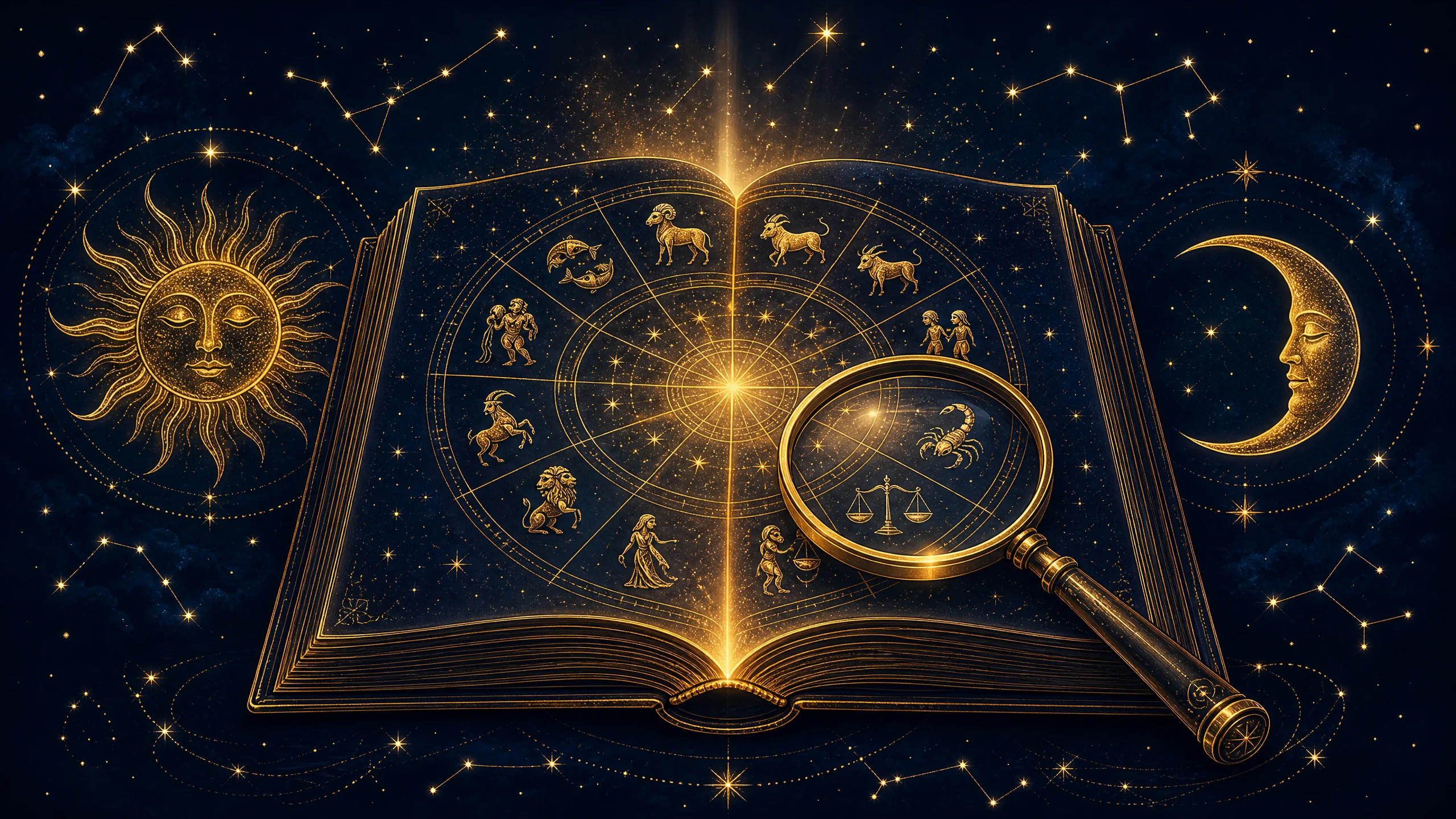
Millions of people read their horoscope every day — but relatively few understand what a horoscope actually is, how it is written, and how to engage with it in a way that is genuinely useful rather than misleading. This guide explains the mechanics of horoscope writing, the difference between a sun-sign forecast and a personalised birth chart reading, and the most effective ways to use daily horoscopes as a tool for reflection.
What a Horoscope Actually Is
A horoscope (from the Greek horoskopos, meaning "observer of the hour") originally referred to the entire birth chart — a map of the sky at the moment of a person's birth. In popular usage today, "horoscope" almost always means a sun-sign forecast: a short reading written for all people born under a particular zodiac sign, based on the current positions of the planets.
This is an important distinction. A sun-sign horoscope is a general forecast for one-twelfth of the world's population. It is written to be broadly applicable, which is why it often feels relevant — a phenomenon psychologists call the Barnum effect (or Forer effect): the tendency to accept vague, general statements as personally meaningful.
A personalised birth chart reading, by contrast, is based on the exact positions of all the planets at the moment of your birth, placed in the twelve houses of your specific chart. It is far more detailed and individually tailored than any sun-sign forecast can be.
How Sun-Sign Horoscopes Are Written
Horoscope writers track the current positions of the planets and note which signs they are transiting. They then interpret how those transits interact with each sun sign's traditional qualities.
For example: if Mars (the planet of action and conflict) is transiting Aries, a horoscope writer might note that Aries people are likely to feel a surge of energy and initiative — because Mars is in its home sign and amplifying Aries's natural drive. For Libra (the opposite sign), the same transit might be written as a period of tension or the need to assert oneself more directly.
The quality of a horoscope depends heavily on the writer's astrological knowledge and their ability to translate planetary symbolism into accessible, useful language. At Orveluna, every forecast is grounded in real planetary data — you can check today's reading for your sign on the Orveluna homepage.
Daily, Weekly, and Monthly Horoscopes: What's the Difference?
Horoscopes come in several timeframes, each with a different focus:
- Daily horoscopes track fast-moving planets — particularly the Moon, which changes signs every two to three days, and Mercury, Venus, and Mars. They are best used as a prompt for the day's energy rather than a specific prediction.
- Weekly horoscopes incorporate the movements of the slower planets and offer a broader thematic overview. They are useful for planning and reflection over a longer arc.
- Monthly horoscopes focus on major planetary events: new moons, full moons, planetary ingresses (when a planet enters a new sign), and retrograde periods. They provide the most useful context for understanding the month's overall themes.
You can read weekly and monthly forecasts for your sign on the Orveluna zodiac sign pages.
How to Read a Horoscope Effectively
1. Know your rising sign, not just your sun sign
Many experienced astrologers recommend reading the horoscope for your rising sign (Ascendant) rather than — or in addition to — your sun sign. The rising sign determines your chart's house structure, so a transit affecting your rising sign's 1st house will be more personally relevant than one affecting your sun sign's 1st house. To find your rising sign, you need your exact birth time and location — use the Orveluna birth sign calculator.
2. Read it as a prompt, not a script
The most useful way to engage with a horoscope is as a prompt for reflection rather than a literal forecast. If today's reading mentions "communication challenges," ask yourself: are there conversations I have been avoiding? Is there something I need to say more clearly? The value lies in the question it raises, not in treating it as fact.
3. Notice what resonates — and what doesn't
Some days a forecast will feel uncannily accurate; other days it will seem completely irrelevant. Both responses are informative. When something resonates, explore why. When it doesn't, notice that too — it may reveal something about your assumptions or your current state of mind.
4. Track patterns over time
Horoscopes become more useful when you read them consistently over weeks and months. You begin to notice patterns — certain planetary transits that consistently correlate with particular kinds of experiences in your life. This is the beginning of a more personal and meaningful engagement with astrology.
5. Maintain a healthy scepticism
Astrology is not a science. Sun-sign forecasts are written to be broadly relatable, which is why they often feel applicable. Maintain a spirit of curious exploration rather than literal belief, and never make important life decisions — financial, medical, relational — based solely on a horoscope.
The Difference Between a Horoscope and a Birth Chart Reading
If you find sun-sign horoscopes interesting but want something more personally relevant, a birth chart reading is the next step. A birth chart maps the positions of all the planets at the exact moment of your birth and places them in the twelve houses — areas of life such as relationships, career, home, and finances.
A professional astrologer can interpret your birth chart in a one-to-one consultation, exploring the themes, strengths, and challenges specific to your chart. This is a fundamentally different experience from reading a sun-sign column — it is personalised, nuanced, and often surprisingly accurate.
Frequently Asked Questions
Should I read my sun sign or rising sign horoscope?
Many astrologers recommend reading both, but prioritising your rising sign if you know it. The rising sign determines your chart's house structure, making transit interpretations more personally relevant. If you don't know your rising sign, use the Orveluna birth sign calculator to find it.
Are horoscopes accurate?
Sun-sign horoscopes are general and broadly applicable by design — they are written for one-twelfth of the population. They are not accurate in the sense of predicting specific events. They can be accurate in the sense of capturing a general energy or theme that resonates with your experience. A personalised birth chart reading is significantly more accurate than a sun-sign forecast.
What is a retrograde, and should I worry about it?
A retrograde occurs when a planet appears to move backward from Earth's perspective (it is an optical illusion caused by the relative speeds of Earth and the planet). Mercury retrograde is the most widely discussed — it is traditionally associated with communication mishaps, travel delays, and technology glitches. Most astrologers treat retrogrades as periods for review and reflection rather than new beginnings, but they are not inherently negative. The best approach is to be a little more careful and patient during retrograde periods, not to panic.
Conclusion
Reading your horoscope well is a skill — one that improves with practice, self-awareness, and a clear understanding of what a sun-sign forecast can and cannot tell you. Used thoughtfully, a daily horoscope is a useful prompt for reflection and a window into the symbolic language of astrology. For a more personalised experience, explore your full birth chart with the Orveluna birth sign calculator, or browse the twelve zodiac sign profiles for deeper context on your sign.