What Is My Chinese Zodiac Sign? Animals, Years & Elements Explained
What is my Chinese zodiac sign? Find your animal by birth year — with the January/February catch, the five elements, and 2026's Fire Horse explained.
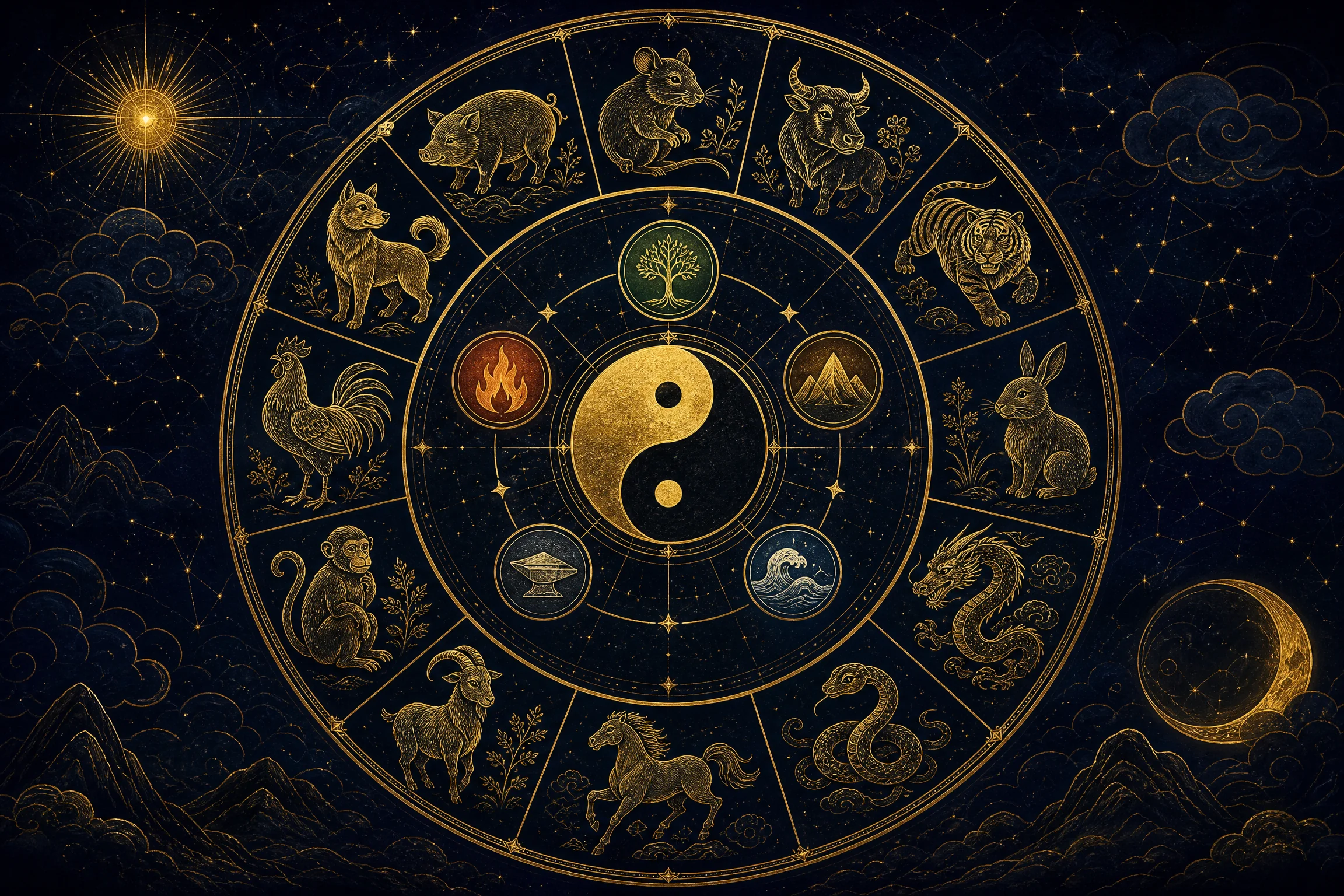
Your Chinese zodiac sign is the animal of your birth year in a 12-year cycle: Rat, Ox, Tiger, Rabbit, Dragon, Snake, Horse, Goat, Monkey, Rooster, Dog, Pig. The catch: the zodiac year starts at Chinese New Year (between January 21 and February 20), not January 1 — born in January or early February, and you may belong to the previous animal. Your full sign also includes an element, like "Water Tiger."
This guide has everything: the complete year-lookup chart, the January/February boundary trap explained, the five elements, traditional compatibility, and how the Chinese system differs from Western sun signs.
Key takeaways - The Chinese zodiac assigns one of 12 animals by birth year — but the year begins at Chinese New Year, never January 1. - Chinese New Year 2026 falls on February 17, 2026, opening the Year of the Fire Horse (not January 29 — that was 2025's date, despite widespread errors online). - Each year also carries one of five elements (Wood, Fire, Earth, Metal, Water), cycling over 60 years. - The system is a cultural tradition for reflection and celebration — not a science.
The 12 Chinese Zodiac Animals (In Order)
Rat, Ox, Tiger, Rabbit, Dragon, Snake, Horse, Goat, Monkey, Rooster, Dog, Pig. Legend says the Jade Emperor held a Great Race across a river, and the animals' finishing order became the zodiac order — the quick-thinking Rat riding the Ox and leaping ahead at the finish line, the diligent Pig arriving last. (The Goat is also called the Sheep or Ram depending on the translation, and the Pig occasionally the Boar.)
Half the animals are yang (Rat, Tiger, Dragon, Horse, Monkey, Dog) and half yin (Ox, Rabbit, Snake, Goat, Rooster, Pig), alternating down the sequence — a reminder that this is a complete cosmological system, not just a mascot list.
Chinese Zodiac Years Chart: Find Your Animal
Look up your birth year below. Important: each animal year starts on the listed Chinese New Year date, not January 1 — if your birthday is in January or early February, check the exact boundary dates in the right-hand column (and the next section).
| Animal | Birth years | Most recent cycle (exact dates) |
|---|---|---|
| Rat | 1960, 1972, 1984, 1996, 2008, 2020 | Jan 25, 2020 – Feb 11, 2021 |
| Ox | 1961, 1973, 1985, 1997, 2009, 2021 | Feb 12, 2021 – Jan 31, 2022 |
| Tiger | 1962, 1974, 1986, 1998, 2010, 2022 | Feb 1, 2022 – Jan 21, 2023 |
| Rabbit | 1963, 1975, 1987, 1999, 2011, 2023 | Jan 22, 2023 – Feb 9, 2024 |
| Dragon | 1964, 1976, 1988, 2000, 2012, 2024 | Feb 10, 2024 – Jan 28, 2025 |
| Snake | 1965, 1977, 1989, 2001, 2013, 2025 | Jan 29, 2025 – Feb 16, 2026 |
| Horse | 1966, 1978, 1990, 2002, 2014, 2026 | Feb 17, 2026 – Feb 5, 2027 |
| Goat | 1967, 1979, 1991, 2003, 2015, 2027 | Feb 6, 2027 – Jan 25, 2028 |
| Monkey | 1968, 1980, 1992, 2004, 2016, 2028 | Jan 26, 2028 – Feb 12, 2029 |
| Rooster | 1969, 1981, 1993, 2005, 2017, 2029 | Feb 13, 2029 – Feb 2, 2030 |
| Dog | 1970, 1982, 1994, 2006, 2018, 2030 | Feb 3, 2030 – Jan 22, 2031 |
| Pig | 1971, 1983, 1995, 2007, 2019, 2031 | Jan 22, 2031 – Feb 10, 2032 |
The January/February Trap (Read This If Born Early in the Year)
Chinese New Year falls on the second new moon after the winter solstice (occasionally the third, when a leap month intervenes). Because the traditional lunisolar year (~354 days) drifts about 11 days against the solar year — corrected every two to three years with an intercalary leap month — the festival floats between January 21 and February 20.
That float creates the single most common Chinese zodiac mistake. Worked example: someone born February 3, 1991 might assume they're a Goat, since 1991 is "a Goat year." But Chinese New Year 1991 fell on February 15 — so a February 3 birthday belongs to the previous animal, the Horse (a Metal Horse, specifically). Any birthday from roughly January 1 to mid-February needs this check. If you were born on the exact boundary day, the changeover is defined by the new moon's precise hour, so a full date-and-time converter is worth consulting.
Chinese New Year 2026: The Year of the Fire Horse
Chinese New Year 2026 is Tuesday, February 17, 2026, opening the Year of the Horse — specifically the Fire Horse, a combination that recurs only every 60 years (the last was 1966). The Horse year runs until February 5, 2027.
A public-service note: you'll find pages online claiming Chinese New Year 2026 falls on January 29. That's wrong — January 29 was the 2025 date, which began the (Wood) Snake year. The confusion is understandable: lunar dates shift annually, and low-quality pages recycle old numbers. The reliable rule is the astronomical one above — second new moon after the winter solstice — which lands on February 17 in 2026.
The Five Elements: Wood, Fire, Earth, Metal, Water
Your Chinese zodiac sign is more than an animal. Each year also carries one of five elements — the Wu Xing or "five phases" — so a full sign reads like "Wood Dragon" or "Fire Horse." Their traditional associations: Wood (growth, creativity), Fire (passion, energy), Earth (stability, nurture), Metal (discipline, precision), Water (wisdom, intuition).
A handy shortcut: your element follows the last digit of your birth year (keeping the Chinese New Year boundary in mind):
- 4 or 5 → Wood · 6 or 7 → Fire · 8 or 9 → Earth · 0 or 1 → Metal · 2 or 3 → Water
So 1990 → Metal Horse, 2024 → Wood Dragon, 2026 → Fire Horse. Each animal meets each element once per 60-year cycle, which is why a Fire Horse year is a once-in-two-generations event.
The five elements also interact in two traditional cycles: a generative cycle (Wood feeds Fire, Fire creates Earth, Earth bears Metal, Metal enriches Water, Water nourishes Wood) and a controlling cycle (Wood parts Earth, Earth dams Water, Water extinguishes Fire, Fire melts Metal, Metal chops Wood). One caution: despite the shared word "elements," Wu Xing describes dynamic transformation — it's not the same system as the four Western elements, and the two traditions don't map onto each other.
The 12 Animals: Traditional Traits & Compatibility
In the tradition, each animal carries characteristic traits and classic best matches (the "trines" of four harmonious trios) plus one "clash" animal directly opposite on the wheel. As with Western compatibility, treat these as cultural symbolism, not verdicts on real relationships.
| Animal | Traditional traits | Best matches | Clash |
|---|---|---|---|
| Rat | clever, adaptable, ambitious | Dragon, Monkey | Horse |
| Ox | reliable, patient, strong | Snake, Rooster | Goat |
| Tiger | brave, confident, passionate | Horse, Dog | Monkey |
| Rabbit | gentle, intuitive, artistic | Goat, Pig | Rooster |
| Dragon | charismatic, powerful, "lucky" | Rat, Monkey | Dog |
| Snake | wise, graceful, strategic | Ox, Rooster | Pig |
| Horse | energetic, independent, loyal | Tiger, Dog | Rat |
| Goat | compassionate, creative, calm | Rabbit, Pig | Ox |
| Monkey | clever, curious, versatile | Rat, Dragon | Tiger |
| Rooster | confident, honest, punctual | Ox, Snake | Rabbit |
| Dog | loyal, fair, protective | Tiger, Horse | Dragon |
| Pig | kind, generous, sincere | Rabbit, Goat | Snake |
The four trines each have a personality of their own: Rat–Dragon–Monkey (the achievers), Ox–Snake–Rooster (the strategists), Tiger–Horse–Dog (the protectors), and Rabbit–Goat–Pig (the harmonizers). Tradition also names six "secret friend" pairs with a special quiet affinity: Rat–Ox, Tiger–Pig, Rabbit–Dog, Dragon–Rooster, Snake–Monkey, and Horse–Goat.
Chinese Zodiac vs Western Zodiac: What's the Difference?
The two systems share a number (twelve) and not much else:
- Cycle: Western signs follow your birth date within the solar year (monthly cycle); Chinese animals follow your birth year on the lunisolar calendar.
- Elements: Western astrology uses four static elements (fire, earth, air, water — see our zodiac elements guide); the Chinese system uses five dynamic phases.
- Full cycle: Western repeats annually; the full Chinese animal × element cycle takes 60 years.
- Depth: Chinese astrology proper goes far beyond the year animal — the complete Four Pillars system uses the animal and element of your birth year, month, day, and hour, so the popular year animal is roughly one-eighth of a full chart.
Claims that certain animals are "equivalent" to certain Western signs are pop-astrology inventions, not tradition. If you'd like your Western sun sign as well, our birth sign calculator computes it from your date, and the zodiac sign dates guide explains that system in full.
Your Zodiac Year (Ben Ming Nian) and Other Living Traditions
The Chinese zodiac isn't a museum piece — it's a living custom. Your ben ming nian, the year your own animal returns, is traditionally treated as a year to move a little more carefully, and the folk remedy is wearing red (socks, bracelets, underwear — gifted by family for extra luck). Dragon years famously bring birth-rate spikes in some East Asian communities, while the Fire Horse year of 1966 coincided with a documented birth-rate dip in Japan due to an old superstition about Fire Horse women — a striking, cautionary example of zodiac beliefs influencing real-world demographics. We mention these as cultural history, never as endorsements.
And the grounding note we owe every reader: the Chinese zodiac is a cultural tradition and symbolic system, not a science — no evidence links birth year to personality or fate. Enjoy it the way millions do: as heritage, celebration, self-reflection, and entertainment.
Frequently Asked Questions
How do I find my Chinese zodiac sign? Find your birth year in the chart above — that's your animal. If you were born in January or before mid-February, check whether your birthday fell before that year's Chinese New Year; if so, you're the previous animal.
What are the 12 Chinese zodiac animals in order? Rat, Ox, Tiger, Rabbit, Dragon, Snake, Horse, Goat, Monkey, Rooster, Dog, Pig — the finishing order of the legendary Great Race held by the Jade Emperor.
Why does my January birthday change my sign? Because zodiac years begin at Chinese New Year (January 21 – February 20), not January 1. A January or early-February birthday usually belongs to the previous year's animal.
What is my Chinese zodiac element? It follows your birth year's last digit: 4/5 Wood, 6/7 Fire, 8/9 Earth, 0/1 Metal, 2/3 Water — with the same Chinese New Year boundary caveat. Born in 1990? Metal Horse. In 1996? Fire Rat.
When is Chinese New Year 2026, and what animal is it? Tuesday, February 17, 2026, beginning the Year of the Fire Horse, which runs until February 5, 2027. Pages claiming January 29 are recycling the 2025 date — that was the Wood Snake year.
Which Chinese zodiac signs are most compatible? Traditionally, animals within the same trine match best: Rat–Dragon–Monkey, Ox–Snake–Rooster, Tiger–Horse–Dog, and Rabbit–Goat–Pig, plus six "secret friend" pairs. The animal directly opposite yours on the wheel is the classic "clash." Treat it as tradition and fun, not relationship law.
Is it bad luck to be in your own zodiac year? Your ben ming nian is traditionally seen as a year for extra care, with wearing red as the customary charm. It's folklore — a cultural practice to enjoy, not a prediction of misfortune.
Is the Chinese zodiac the same as Chinese astrology? Not quite. The 12 animals are the popular surface; full Chinese astrology (the Four Pillars) also uses the animal and element of your birth month, day, and hour — eight characters in total. The year animal is roughly one-eighth of the picture.
The Bottom Line
Your Chinese zodiac sign is your birth year's animal — checked against the Chinese New Year boundary if you were born early in the year — plus an element that completes the picture. With 2026 ushering in the rare Fire Horse on February 17, there's never been a better year to learn the system.
Exploring astrology from every angle? Find your Western sun sign with the free Orveluna birth sign calculator, browse all twelve Western sign profiles, or check any two signs with the compatibility tool.